
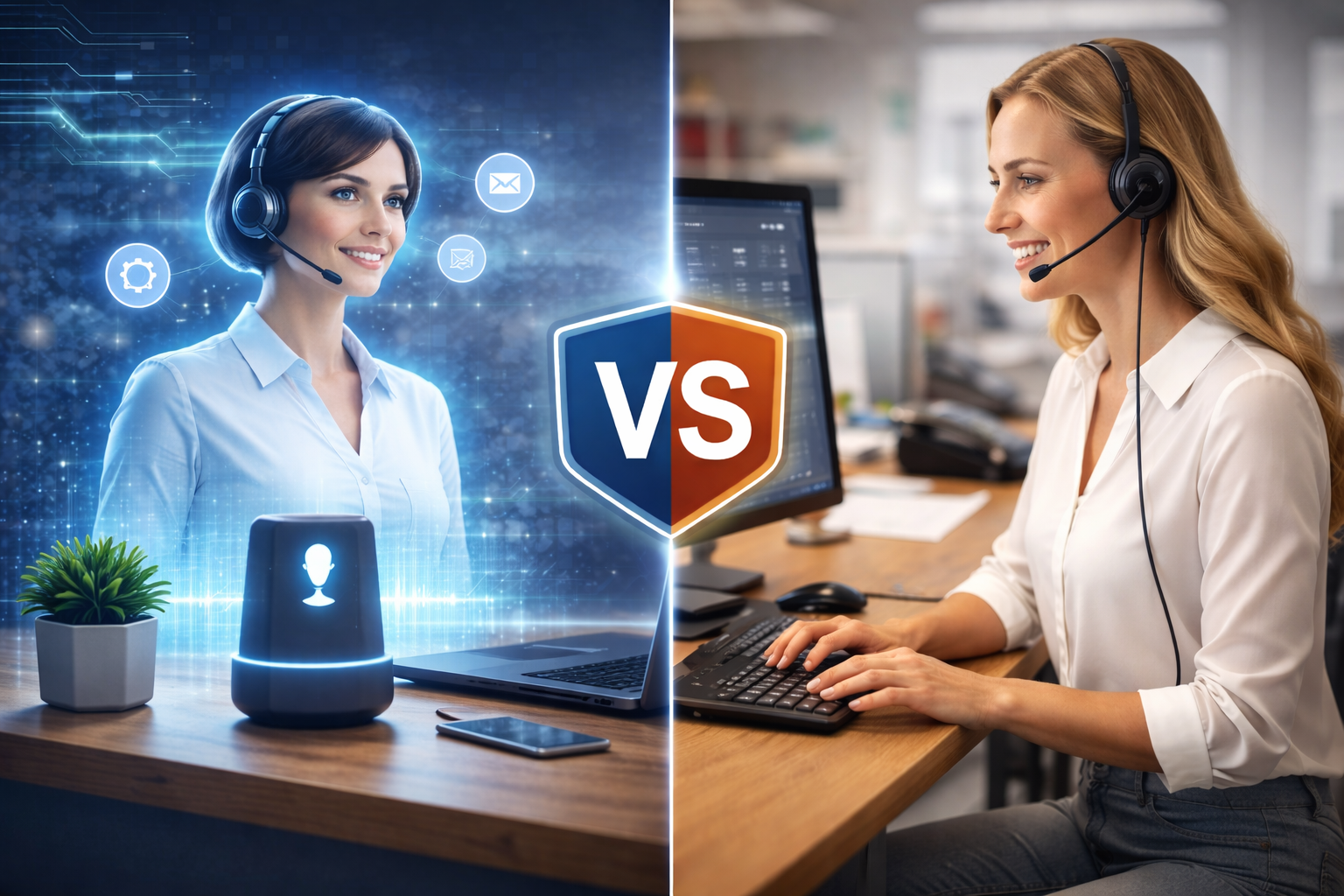
AI Receptionist vs Traditional Answering Service: A Complete Comparison
Making the Right Choice for Your Business
If you're reading this, you've probably reached a tipping point. Calls are going to voicemail. Leads are slipping away. You know you need help answering the phone, but you're not sure which direction to go.
Traditional answering services have been the default solution for decades - a team of human operators at an outsourced call centre who answer your phone on your behalf. They follow a script, take messages, and pass information along. It's a proven model, and for some businesses, it still makes sense.
But AI receptionists have matured dramatically in the last two years. They're no longer the clunky, robotic systems that frustrated callers with "press 1 for sales." Modern AI voice agents hold natural, fluid conversations. They understand context, answer questions intelligently, and integrate directly with your business tools.
So which one is right for your business? Let's break it down honestly - the costs, the capabilities, the trade-offs, and the situations where each option genuinely shines.
The Real Cost Comparison
Let's start with the number that matters most to most small business owners: what does this actually cost?
Traditional Answering Service Costs
Traditional answering services typically charge on a per-minute or per-call basis, layered on top of a monthly base fee. Here's what the pricing landscape looks like:
- Monthly base fee: $200–$1,000+, depending on the plan tier and expected volume
- Per-minute charges: $0.75–$1.50 per minute of operator time
- Setup fees: $50–$200 for onboarding, script creation, and account configuration
- After-hours premiums: Many services charge 1.5x–2x rates for evenings, weekends, and holidays
- Holiday surcharges: Expect additional fees for public holidays - precisely when coverage matters most
- Overage charges: Exceed your plan's included minutes and you'll pay premium per-minute rates
- Script update fees: Some services charge for modifying your call scripts
For a small business receiving 100–200 calls per month with average call durations of 3–4 minutes, monthly costs typically land between $400–$800. For higher-volume businesses, you can easily cross $1,500/month.
And those costs are sticky. They don't decrease as your business gets more efficient - if anything, they grow with your call volume.
AI Receptionist Costs
AI receptionists like OnCallClerk operate on a fundamentally different pricing model:
- Monthly subscription: flat-rate plans that include a set number of minutes
- No per-call charges: it's the same price whether you get 10 calls or 100 calls within your plan
- No setup fees: create your account, configure your agent, and go live in minutes
- No after-hours premiums: 2 AM on Christmas Day costs exactly the same as 10 AM on a Tuesday
- No overage surprises: usage is tracked transparently in your dashboard, and you can upgrade plans if you need more capacity
OnCallClerk's plans start with a Basic tier for small businesses, scale up to a Professional tier for growing companies, and offer an Enterprise tier with unlimited minutes for high-volume operations. Every plan includes a 14-day free trial.
The Total Cost Picture
When you factor in the hidden costs that answering services accumulate - holiday premiums, after-hours rates, script changes, overage fees - an AI receptionist typically delivers 60–80% cost savings compared to a traditional service at equivalent call volumes.
But cost isn't just about what you pay the service. It's also about what you save in operational overhead. An AI receptionist requires no ongoing management, no weekly check-in calls with your account manager, no disputes over billing, and no renegotiation of contracts. It's one subscription, one dashboard, one predictable cost.
Availability and Consistency
This is where the gap between AI and human services starts to become profound.
Traditional Answering Service
Yes, most answering services offer 24/7 coverage. But there's a meaningful difference between "available" and "consistently good."
Answering services staff their call centres in shifts. Daytime shifts typically have the most experienced operators. Evening and overnight shifts are often covered by less experienced staff, part-time workers, or operators handling calls for dozens of different businesses simultaneously. Each operator juggles multiple client accounts, switching between different scripts and business contexts throughout their shift.
The result? Quality varies. An operator who's been handling calls for your dental practice for six months will sound confident and knowledgeable. The overnight replacement who's reading your script for the first time while simultaneously monitoring three other accounts? Less so.
Holiday coverage amplifies this problem. Services charge premium rates for holiday shifts, and the operators working those shifts are often the least familiar with your specific business. Callers notice.
AI Receptionist
An AI receptionist delivers genuinely identical quality on every single call, regardless of when that call happens. There's no training curve, no fatigue, no bad days, and no shift changes.
At 3 AM on a Sunday, your AI agent answers with the same warmth, accuracy, and professionalism as it does at 10 AM on a Tuesday. It doesn't need coffee. It doesn't get flustered by a difficult caller at the end of a long shift. It never accidentally reads the wrong script because it's juggling too many accounts.
This consistency matters more than most businesses realise. When a homeowner discovers a burst pipe at midnight, the quality of that first phone interaction determines whether they trust you enough to book the job. When a potential client calls a law firm after hours to ask about representation, the professionalism of that conversation shapes whether they follow up or call the next firm on their list.
Capabilities: What Each Option Can Actually Do
This is the area where the comparison gets most interesting, because AI receptionists and traditional services have fundamentally different strengths.
What Traditional Answering Services Do Well
Human empathy in emotional situations. When a caller is upset, frightened, or dealing with a sensitive issue, a skilled human operator can read emotional cues, adjust their tone, and provide genuine comfort in ways that AI hasn't fully replicated. For businesses where callers frequently arrive in distress - funeral homes, emergency medical services, crisis counselling - human empathy remains valuable.
Complex, unstructured problem-solving. If a call requires navigating a truly novel situation that falls entirely outside normal parameters, a human operator can improvise, ask creative follow-up questions, and find a path forward. They can also make judgement calls about when to escalate or when a situation requires immediate attention.
Handling extremely heavy accents or unusual speech patterns. While AI speech recognition has improved dramatically, human operators still have an edge with very thick accents, callers with speech impediments, or conversations in mixed languages.
What Traditional Answering Services Can't Do
Access your systems in real time. An answering service operator can't check your calendar availability, look up a customer in your CRM, verify an order status, or pull pricing from your database. They can only work with whatever static information is on their script. This means they can't book appointments, can't provide real-time answers, and can't complete transactions. They take a message, and you call back later.
Provide structured data and analytics. Answering services typically deliver messages via email, text, or a web portal. But the information is unstructured - notes typed by an operator, often inconsistent in format and completeness. There's no automatic transcription, no searchable database, no call analytics, no trend identification.
Scale without proportional cost increases. Every additional minute of call time costs more money. Every additional hour of coverage costs more money. There's a direct, linear relationship between how much you use the service and how much it costs.
What AI Receptionists Do Well
Consistent brand voice across every interaction. Your AI agent uses the exact voice, tone, and personality you configure. It delivers your messaging precisely as intended, every time. No operator has a bad day and snaps at a caller. No replacement covers your calls without knowing your business.
Real-time system integration. This is the AI receptionist's defining advantage. An AI agent like OnCallClerk can connect directly to your Google Calendar, check live availability, and book appointments during the call. It can send follow-up emails through Gmail. It can pull data from external APIs - inventory levels, order statuses, account information - and reference it in real time during the conversation. It can push new lead data directly into your CRM or Google Sheets.
The caller gets their answer immediately. No "someone will call you back." No message-taking. Actual resolution.
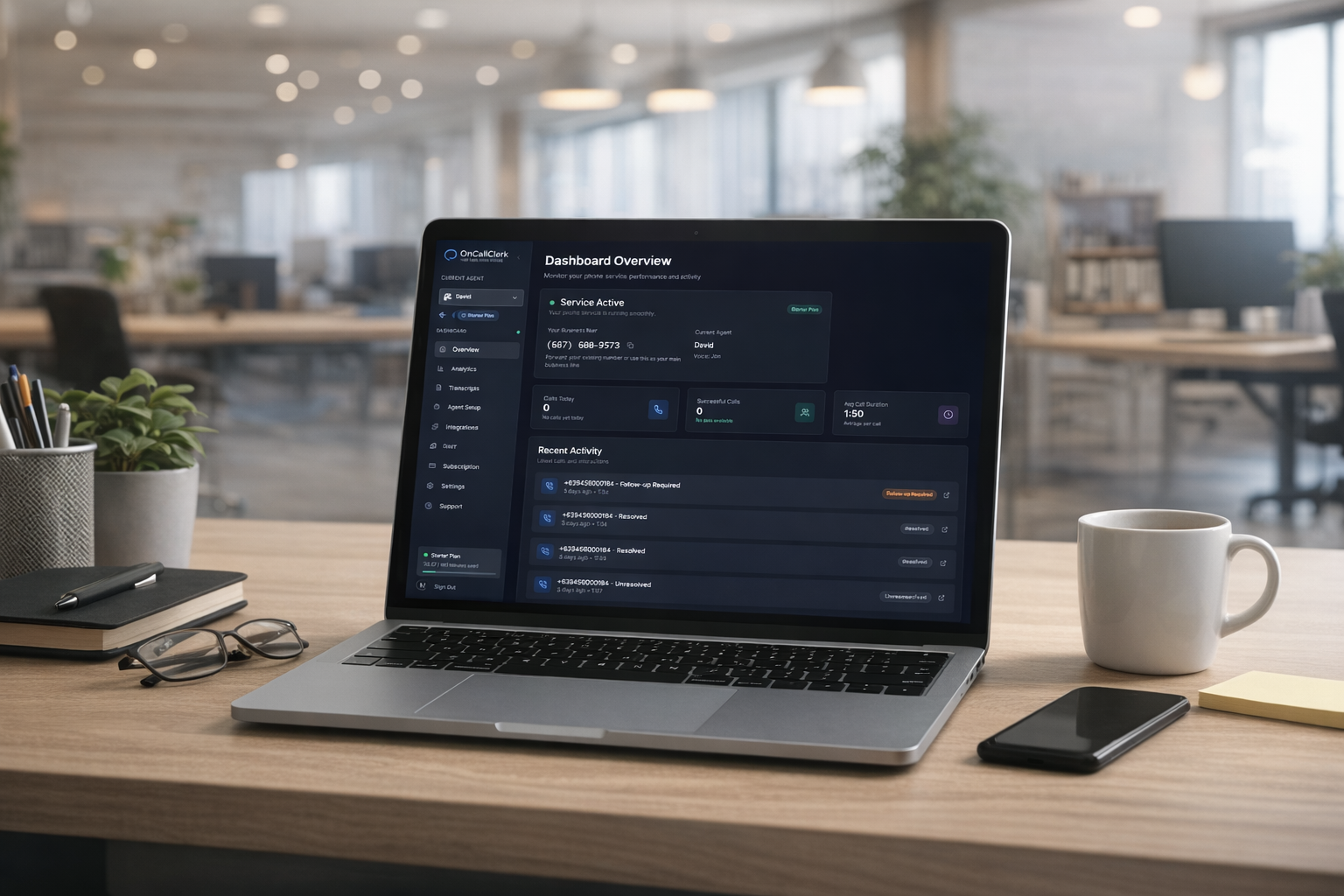
Automatic transcription and analytics. Every call is fully transcribed, searchable, and stored. You can read the complete conversation, search across all your call history by keyword, filter by call type or outcome, and export to CSV. The analytics dashboard shows you call volume trends, peak hours, common topics, answer rates, average duration, lead generation metrics, and conversion tracking.
Intelligent call routing and escalation. AI agents don't just answer and take messages - they triage. They can qualify leads by asking the right questions, resolve routine inquiries completely, and recognise when a situation genuinely needs a human. When escalation is triggered, the AI transfers the call with full context so the human doesn't need to restart the conversation.
Where AI Receptionists Are Still Improving
Deeply emotional conversations. While modern AI voices are remarkably natural and empathetic, callers in extreme emotional states may still prefer a human presence - particularly for grief, medical emergencies, or highly sensitive legal matters.
Completely novel situations. AI agents are trained on your business information and instructions. If a caller presents a scenario completely outside those parameters, the AI may need to escalate. Human operators have a slight edge in pure improvisation.
Industry-Specific Recommendations
Different businesses have different calling patterns. Here's how the choice breaks down by industry:
Home Services (Plumbing, HVAC, Electrical, Cleaning)
Recommendation: AI Receptionist
Home service businesses get high volumes of straightforward calls: scheduling, pricing questions, service area inquiries, and emergency dispatch. These are exactly the types of calls an AI agent handles brilliantly. The calendar integration means appointments are booked in real time, and the 24/7 coverage catches those crucial after-hours emergency calls that drive the most revenue.
A plumber who adopts an AI receptionist stops missing the midnight burst-pipe call that turns into a $2,000 job.
Medical and Dental Practices
Recommendation: AI Receptionist with escalation configured
Appointment scheduling, insurance questions, office hours, and new patient inquiries make up the vast majority of calls to medical offices. An AI agent with a medical practice template handles all of this seamlessly. Set the escalation policy to transfer urgent medical concerns or distressed callers to your clinical staff, and you've covered every scenario.
Legal Firms
Recommendation: AI Receptionist
Law firms live and die by responsiveness. When a potential client calls about representation, they're often calling multiple firms. The one that answers professionally and captures their details immediately wins the client. An AI receptionist answers on the first ring, qualifies the inquiry, gathers key details, and can even send a follow-up email - all before the call ends. After-hours coverage is particularly valuable for criminal defence and personal injury firms where clients often call outside business hours.
Funeral Homes and Crisis Services
Recommendation: Traditional Answering Service or Hybrid
This is the clearest case for human operators. Callers are often in acute emotional distress and need genuine human compassion. A hybrid approach can work - let AI handle calls during business hours to qualify and route, but have human operators cover after-hours calls when someone may need emotional support.
Real Estate
Recommendation: AI Receptionist
Real estate agents are constantly out showing properties, attending inspections, and meeting clients. They can't answer every call. An AI agent with the real estate template can handle property inquiries, qualify leads by asking about budget, timeline, and preferences, schedule viewings, and send follow-up emails with property information. Every lead captured is potential commission saved.
Restaurants and Hospitality
Recommendation: AI Receptionist
Reservation calls, menu questions, hours of operation, event inquiries, dietary accommodation questions - these are repetitive, high-volume, and perfectly suited to AI. Calendar integration handles bookings, and the friendly personality type creates the warm, welcoming tone that restaurants want. Bonus: the AI never puts a caller on hold during a dinner rush.
E-commerce
Recommendation: AI Receptionist with API integrations
With API integrations, an AI agent can look up order statuses, process return requests, check inventory, and answer product questions - all pulling live data from your systems. This is territory where answering services simply can't compete because they have no access to your backend systems.
The Hybrid Approach: Best of Both Worlds
Many businesses are discovering that the choice doesn't have to be binary. A hybrid model lets you optimise for both cost and quality:
- AI handles the front door. Every call is answered by your AI agent, which greets the caller, identifies their need, and handles the interaction.
- Routine calls stay with AI. Scheduling, FAQs, hours, directions, pricing, status updates - the AI resolves these completely. No human needed.
- Complex or emotional calls transfer to a human. The AI recognises when a situation requires escalation and transfers the call with full context. The human picks up already knowing who the caller is and what they need.
OnCallClerk makes this easy with configurable escalation policies. You can set the AI to escalate only on complex queries, only when the caller requests it, or always offer the option. The escalation phone number can be your mobile, your office line, or even a traditional answering service for after-hours human coverage.
This hybrid approach typically handles 70–85% of calls entirely through AI, with only the genuinely complex 15–30% reaching a human. The cost savings are dramatic, the coverage is seamless, and the caller experience is excellent regardless of which path their call takes.
Making the Switch: What to Expect
If you're currently using a traditional answering service and considering an AI receptionist, here's what the transition typically looks like:
Week 1: Setup and parallel running. Set up your AI agent (it takes about 10 minutes), configure your knowledge base and call rules, and run the AI alongside your existing service. Forward a subset of calls to the AI and compare the results.
Week 2: Review and refine. Read through your transcripts, identify any gaps in your agent's knowledge, and add FAQs or update system instructions accordingly. Most businesses find that 80%+ of calls are handled well from day one, and the remaining gaps are easy to close.
Week 3–4: Full transition. Once you're confident in the AI's performance, cancel your traditional service and route all calls to your AI agent. Monitor the analytics closely for the first few weeks to catch anything that needs adjustment.
Ongoing: Let the data guide you. Your analytics dashboard will surface insights about call patterns, common questions, and areas for improvement. Use this data to continuously refine your agent.
The Bottom Line
Traditional answering services served small businesses well for decades. They solved a real problem - you can't answer the phone if you're busy - and they deserve credit for that.
But the technology landscape has shifted. AI receptionists now offer:
- 60–80% lower costs with no hidden fees or surcharges
- True 24/7/365 coverage at the same quality level, regardless of time or day
- Real-time system integration that lets the AI actually resolve calls, not just take messages
- Complete call analytics and transcription that turns your phone channel into a data source
- Consistent brand experience on every single call
- Instant setup with no contracts, script development, or onboarding periods
For most small to medium businesses, the AI receptionist isn't just a cheaper option - it's a fundamentally more capable one. It doesn't just answer your phone. It answers questions, books appointments, captures leads, sends follow-ups, and gives you data from every conversation.
The exception is businesses where callers are routinely in emotional distress and need genuine human compassion. For those situations, a traditional service or hybrid approach still makes sense.
For everyone else? The maths, the capabilities, and the customer experience all point in the same direction.
Try OnCallClerk free for 14 days - no credit card required. See for yourself how an AI receptionist performs compared to what you're using today.