
The Communication Challenge for Small Businesses
Every small business owner knows the feeling: you're in the middle of helping a customer, and the phone rings. You can't answer it. By the time you call back, that potential lead has already moved on to someone who picked up. It's a daily reality that quietly chips away at revenue, reputation, and growth.
But the communication challenge facing small businesses goes much deeper than missed calls. It's a systemic problem rooted in how customers actually want to interact with businesses, what it costs to meet those expectations, and the invisible data that falls through the cracks every single day.
People Still Pick Up the Phone - A Lot More Than You'd Think
In a world of chatbots, email, and social media DMs, you might assume phone calls are a relic of the past. The data tells a very different story.
According to a McKinsey & Company study on the state of customer care, 71% of Gen Z consumers - the most digitally native generation - would still reach out to customer support via a live phone call. That's not your grandparents' generation clinging to old habits. That's the youngest segment of the workforce and consumer base actively choosing voice as their preferred channel for resolving issues.
The Zendesk Customer Experience Trends Report for 2026 backs this up further. Their research found that 70% of consumers expect anyone they interact with to have the full context of their situation - the kind of nuanced, dynamic exchange that phone conversations handle far better than asynchronous text channels. When a customer has a complex question, a complaint, or an urgent need, they don't want to wait for an email reply or navigate a chatbot decision tree. They want to talk to someone.
Salesforce's State of Service report adds another dimension: 57% of business leaders expect customer service call volumes to increase by as much as one-fifth over the next one to two years. Phone call volume isn't declining - it's growing. And for small businesses, that rising tide of inbound calls creates a real operational problem.
The old statistic that 85% of callers who can't reach a business won't call back has been circulated for years, and while the exact number varies by industry, the underlying truth holds firm. Zendesk's data shows that more than half of consumers will switch to a competitor after just one bad experience, and 73% will switch after multiple bad experiences. A missed call is, at minimum, a friction point - and at worst, a permanent loss.
For a small business without a dedicated receptionist, every unanswered ring represents a potential customer who simply went elsewhere.
The Cost and Time Overhead of Manning the Phones
Let's talk about what it actually costs to keep the phones covered.
Hiring a full-time receptionist in the US averages somewhere between $30,000 and $45,000 per year in salary alone according to the Bureau of Labor Statistics, before benefits, training, and overhead. For many small businesses - a local plumber, a dental practice, a law firm with three attorneys - that's a significant line item that doesn't directly generate revenue.
But it's not just about salary. It's about the opportunity cost of time. When the business owner or a skilled employee is the one answering the phone, they're pulled away from billable work, client meetings, or operations. A plumber who stops to answer a call mid-job, a salon owner who pauses a client's appointment to book another one, a solo attorney who interrupts research to take a new inquiry - these interruptions compound throughout the day.
Then there's the coverage problem. A single receptionist can only work so many hours. Evenings, weekends, lunch breaks, holidays, and sick days all create gaps where calls go to voicemail. And as we've established, voicemail is where leads go to die. According to Salesforce, 82% of service professionals say customer expectations are higher than they used to be, yet service reps spend less than half their time (46%) actually interacting with customers, with the rest consumed by admin tasks.
Traditional answering services offer another option, but they come with their own drawbacks. They typically charge per minute or per call, with monthly costs ranging from $200 to $2,000+ depending on volume. The operators follow rigid scripts, can't access your systems, and often provide a generic experience that doesn't represent your brand. Customers can tell when they're talking to a third-party service, and it erodes trust.
For multi-location businesses, the problem multiplies. Each location may need its own phone coverage, its own staff, its own processes. The overhead scales linearly while the quality often degrades.
The Analytics Black Hole
Perhaps the most overlooked cost of traditional phone systems is the complete lack of actionable data. Every time a call happens, valuable information is exchanged - but almost none of it is captured systematically.
Think about what flows through your phone lines on any given day: What are the most common questions customers ask? How many callers are new leads versus existing customers? What time of day generates the most calls? How long does each call take? What percentage of calls result in a booked appointment or a sale? Which marketing campaign is driving calls?
With traditional phone setups, the answer to all of these questions is usually "we don't know." You might keep a paper log or a spreadsheet, but it's incomplete, inconsistent, and rarely analyzed. The data that could inform your marketing spend, staffing decisions, service improvements, and sales strategy simply evaporates.
Even businesses that record calls face a practical problem: who has time to listen to dozens of recordings? The information is technically captured but practically inaccessible. Zendesk found that 6 in 10 customer service agents say a lack of consumer data often causes negative experiences. Without structured data from phone interactions, you're operating blind - making decisions based on gut feel rather than evidence.
This analytics gap puts small businesses at a significant disadvantage compared to larger competitors who have dedicated CRM systems, call center analytics platforms, and data teams that turn every customer interaction into an insight.
Enter AI Voice Agents
This is where AI voice agents fundamentally change the equation. Not as a marginal improvement over voicemail, and not as a fancy auto-attendant with slightly better menu options - but as a genuine step change in how small businesses can handle phone communication.
What Modern AI Voice Agents Actually Do
Let's be clear about what we're talking about. Modern AI voice agents aren't the robotic "press 1 for sales, press 2 for support" systems of the past. They use advanced natural language processing to have fluid, human-like conversations. A caller speaks normally - "Hi, I need to schedule a cleaning for next Thursday if you have anything in the afternoon" - and the AI understands the intent, checks availability, and books the appointment. No menus, no hold music, no frustration. (See how this works in practice for cleaning companies.)
This capability has matured rapidly. Zendesk's 2026 research found that 81% of consumers now say AI has become part of modern customer service, and nearly 7 in 10 consumers believe that more natural-sounding AI via phone would enhance their experience. Perhaps most telling, 60% of consumers actively want companies to adopt advanced Voice AI technologies. The consumer readiness is there.
Always On, Always Consistent
The most immediate benefit is coverage. An AI voice agent works 24 hours a day, 7 days a week, 365 days a year. There's no lunch break, no sick day, no "sorry, we're closed for the holiday." At 3 AM when a homeowner discovers a burst pipe and frantically calls every plumber in the area, your AI agent picks up on the first ring, gathers the details, and books an emergency appointment.
But it's not just about being available - it's about being consistently good. A human receptionist has great days and bad days. They might be short with a caller after a stressful morning, or forget to mention a current promotion, or fumble through an answer they're not sure about. An AI agent delivers the same professional, thorough, on-brand experience on every single call. It never gets flustered by a difficult caller, never forgets your pricing, and never accidentally gives out wrong information.
Salesforce's research found that 88% of service professionals say conversational AI accelerates resolution times and 87% say it frees representatives to handle more complex issues. For small businesses where the "representative" is often the owner themselves, that freed-up time is even more valuable.
Intelligent Call Handling, Not Just Answering
A good AI voice agent does much more than pick up and take a message. It triages, qualifies, and routes intelligently.
When a new lead calls, the AI can ask qualifying questions: What service are you interested in? What's your timeline? What's your budget range? By the time the business owner reviews the call summary, they have a pre-qualified lead with all the relevant details - not just a name and phone number on a sticky note.
For existing customers, the AI can handle routine requests directly. Appointment scheduling, hours of operation, service area questions, pricing inquiries, status updates - these make up the majority of inbound calls for most small businesses, and an AI agent can resolve them completely without any human involvement. According to Salesforce, 30% of service cases were resolved by AI in 2025, and that number is expected to rise to 50% by 2027.
Source: Salesforce State of Service (2025)
For urgent or complex situations that genuinely need a human, the AI recognises this and routes accordingly - forwarding the call with full context so the customer doesn't have to repeat themselves. It's the best of both worlds: automation for routine tasks, human touch for high-stakes situations.
Integrations That Extend the Value
Modern AI voice agents don't operate in isolation. They connect to the tools your business already uses, which dramatically expands what they can do during a conversation.
Calendar integrations allow the AI to check real-time availability and book appointments directly into your Google Calendar or other scheduling systems. No double-bookings, no back-and-forth, no "let me check and call you back."
Email integrations let the AI send confirmation emails, follow-up information, or detailed quotes to callers immediately after a conversation. A caller asks about your services, and before they've even hung up, a personalised email with your pricing and a booking link lands in their inbox.
API integrations open up even more possibilities. Your AI agent can pull data from your CRM, check inventory in your management system, look up order statuses, or push new lead information directly into your sales pipeline - all during the live conversation. This means the AI doesn't just answer the phone; it becomes an active participant in your business operations.
These integrations transform the AI from a simple answering service into an intelligent front-office system that connects your phone channel to the rest of your tech stack.
Finally: Real Data from Every Call
This is where AI voice agents deliver a benefit that traditional phone setups simply cannot match - structured, searchable, actionable analytics from every conversation.
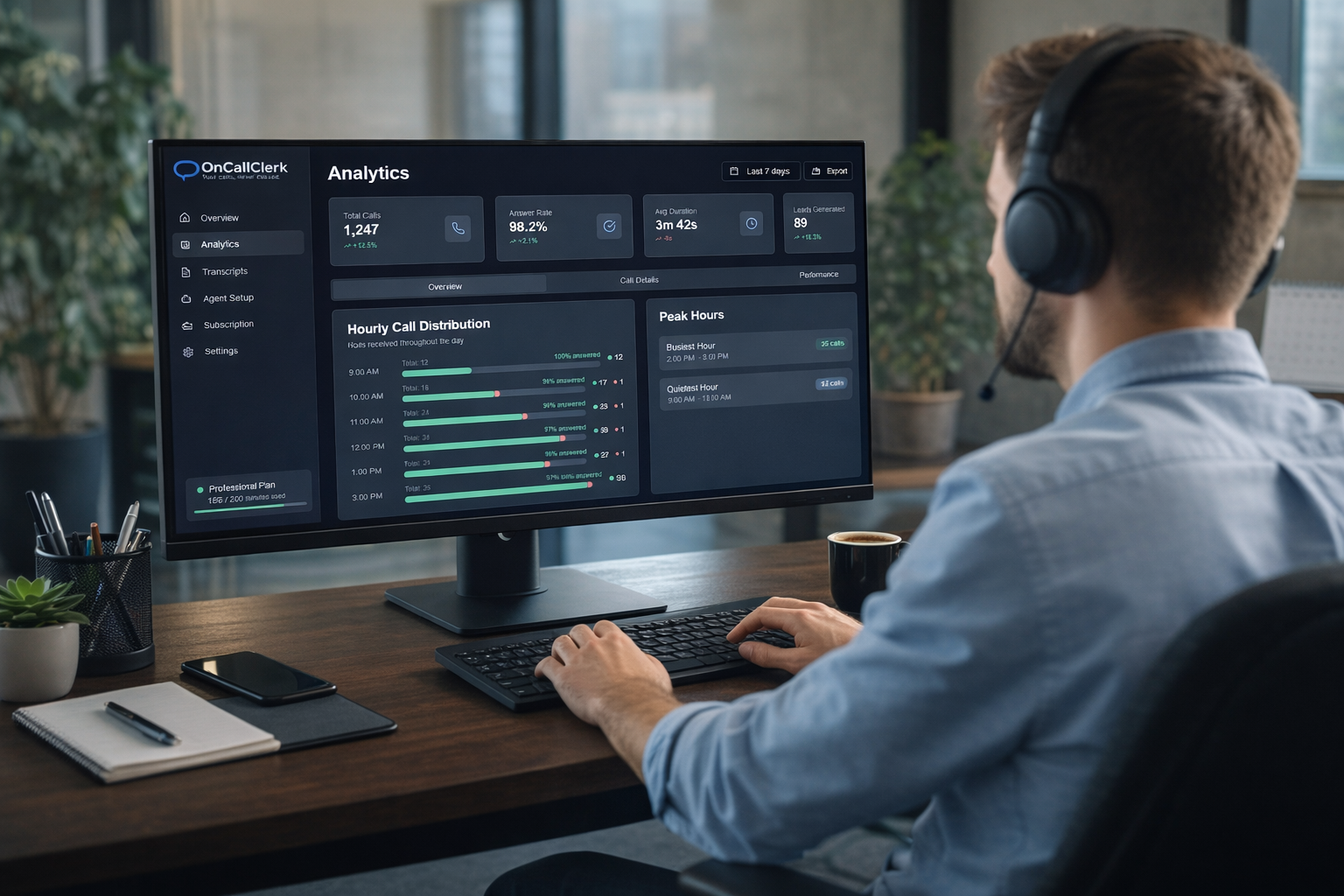
Every call is automatically transcribed and analyzed. You get complete transcripts you can search and review, but more importantly, you get aggregated insights: call volume trends by day and hour, common topics and questions, resolution rates, average call duration, sentiment analysis, and conversion metrics.
Imagine being able to see that 40% of your calls this month were about a specific service you barely promote - that's a marketing opportunity hiding in your call data. Or discovering that calls spike between 5-7 PM when you're currently closed - that's revenue you're leaving on the table. Or finding that customers keep asking about a service you don't offer - that's a product development insight.
This kind of data has historically been available only to large companies with expensive call center software and dedicated analytics teams. AI voice agents democratize access to these insights, giving a five-person business the same visibility into customer interactions that a 500-person company has.
For teams already using AI tools, the ROI is clear. Zendesk found that 90% of CX Trendsetters report positive ROI on AI tools, and Salesforce reports that over 90% of organizations with AI report time and cost savings.
Source: Zendesk CX Trends Report (2026)
Getting Started with an AI Voice Agent
The barrier to entry for AI voice agents has dropped dramatically. You don't need a technical background, a development team, or a six-month implementation project.
Here's what it actually looks like with a platform like OnCallClerk:
1. Create Your Agent in Minutes
Sign up and configure your AI agent through a straightforward dashboard. You define your business name, hours of operation, services offered, common questions and answers, and your preferred call handling rules. There's no coding involved - it's more like filling out a thorough business profile.
You choose from a selection of natural-sounding voices and set the tone and personality of your agent. Want it to be warm and casual for a family restaurant? Professional and precise for a law firm? Energetic and upbeat for a fitness studio? You control exactly how your business sounds on the phone.
2. Connect Your Integrations
Link your Google Calendar so the AI can schedule appointments in real time. Connect Gmail so it can send follow-up emails. Set up API connections to pull from or push data to your existing systems. Each integration takes just a few minutes and dramatically expands your agent's capabilities.
3. Get Your Dedicated Phone Number
OnCallClerk provides a dedicated phone number for your AI agent. You can use it as your primary business line, set it up as a forwarding destination for your existing number, or use it specifically for after-hours coverage. Calls to this number are answered instantly by your AI agent.
4. Monitor, Refine, and Grow
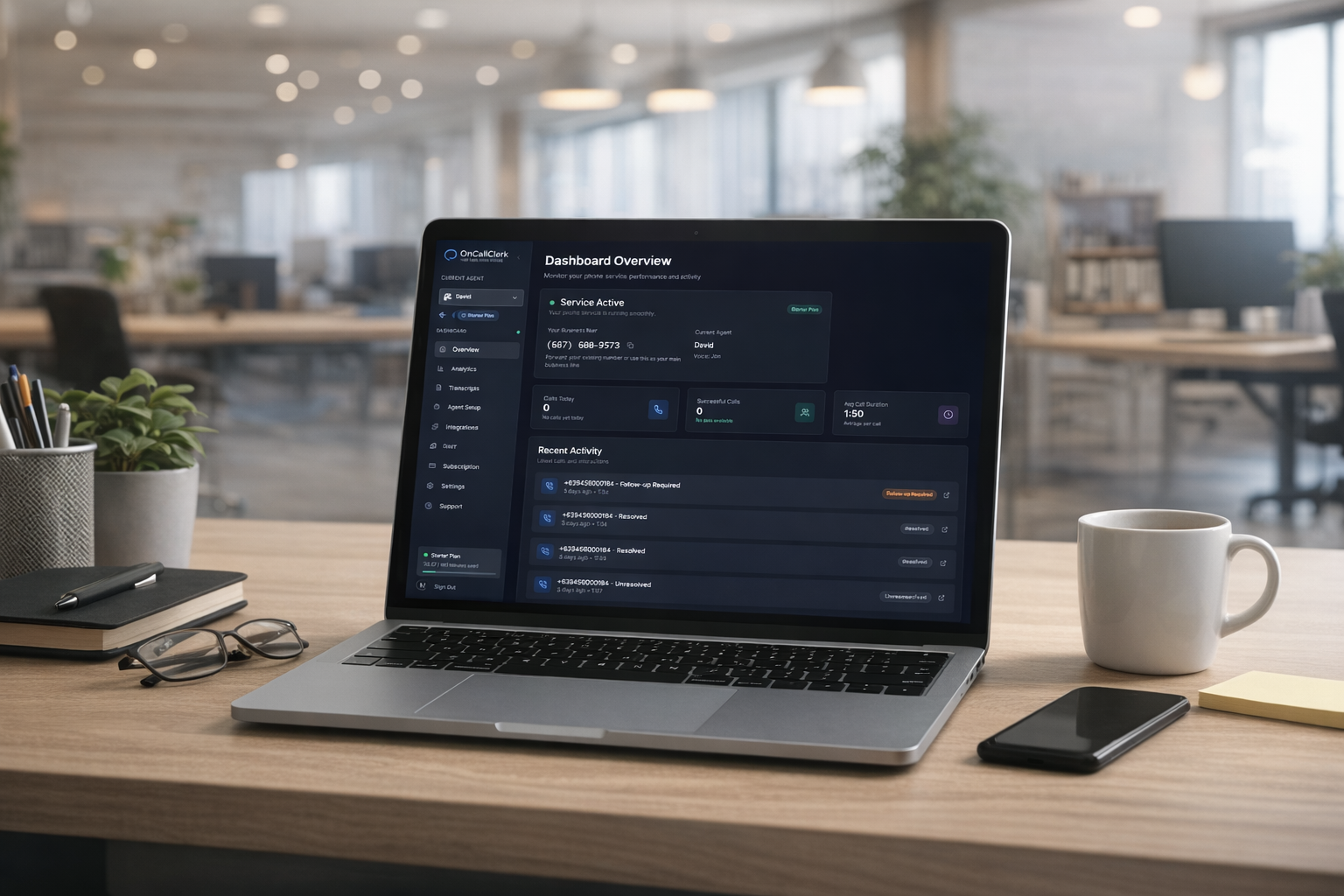
Once live, you have full visibility into every call through your dashboard. Read transcripts, review analytics, and refine your agent's responses based on real data. The system learns and improves, and you can adjust settings at any time as your business evolves.
The Bottom Line
The communication challenge facing small businesses isn't going away. Customer expectations continue to rise, phone call volumes are growing, and the cost of human staffing keeps climbing. But for the first time, there's a solution that doesn't require enterprise budgets or technical expertise.
AI voice agents give small businesses something that was previously out of reach: professional, 24/7 phone coverage that captures every lead, handles routine requests, integrates with existing tools, and turns every call into actionable data. It's not about replacing the human touch - it's about making sure no customer ever reaches a voicemail box and gives up.
The businesses that adopt this technology early will have a measurable advantage: more leads captured, better customer experiences, lower operational costs, and data-driven insights that fuel smarter decisions.
Ready to never miss another call? Get started with OnCallClerk today.
Keep Reading
- AI Voice Agents for Small Business (2026 Guide) - Cost ranges, use cases, and provider fit for SMBs.
- The Real Cost Savings of AI Receptionists - Detailed financial breakdown of AI vs human phone answering costs.
- How Much Revenue You Lose From Missed Calls - The real dollar cost of unanswered calls, with calculations by industry.
- Why 90% of Callers Don't Leave Voicemail - The psychology behind voicemail abandonment and where callers go instead.
- How to Hire an AI Receptionist - What to look for when choosing an AI receptionist platform.
- How to Start an AI Call Center - Build a business around AI voice agents.
See our virtual receptionist, phone answering service, and Call Clerk pages, or explore solutions for electricians, accounting firms, and IT support.